Bouncy Weapons review: physics-based incremental RPG with big skill tree
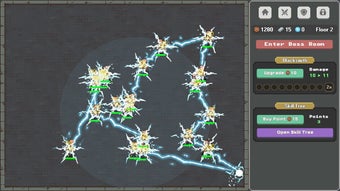
Bouncy Weapons from LeenGameDev is an incremental role-playing title that sends ricocheting weapons through enclosed arenas as the central combat hook. The game pairs physics-driven auto-attacks with strategic progression: players manage a massive branching skill tree, collect loot, and forge tiered weapons while facing timed bosses. Key systems include multiple weapon classes and autonomous Strikers. Fans of incremental RPGs who enjoy deep build experimentation and physics quirks form the intended audience.
Weapons handle aiming while progression drives each run
The central loop places the physics engine in control of targeting: weapons ricochet around an enclosed arena and strike enemies automatically, while the player focuses on long-term upgrades. This separation makes sessions revolve around clearing floors and entering timed boss rooms, where the choice to raise challenge affects rewards. The result is a loop that emphasizes strategic selection of upgrades over moment-to-moment aiming.
Build variety matters because classes and allies behave differently
Variety arises from distinct weapon classes and supporting systems. Bazookas, Daggers, and Archers each produce different ricochet behaviors, and autonomous Strikers assist during arena clears. Players fine-tune damage through the blacksmith's tier upgrades and pursue rare encounters like Treasure Goblins for loot spikes. The interaction between weapon behavior and striker setups defines how efficiently you clear dense enemy waves.
Runs suit modest hardware but the interface needs work on large displays
The game has a small footprint, needing about 400 MB of available storage and only 512 MB of RAM on Mac OS X 10.6 or later, which suits lower-end desktop setups. Reported issues include UI scaling problems on high-resolution monitors, which can complicate menu navigation and stat reading. The developer's indie scope explains the modest requirements, but players using very large displays should check how the interface scales.
The design rewards planning, though the early ramp asks for patience
The learning curve leans toward deliberate planning: a massive branching skill tree and layered upgrades demand investment to access stronger synergies. The Rage System increases enemy density in exchange for higher loot, making risk choices meaningful. Some players note a slow early ramp that delays power spikes, so the game favors experimentation across multiple runs rather than instant gratification from short sessions.
Best for patient players who enjoy tinkering with systems
The game is a solid pick for players who enjoy slow-burn, systems-driven progression and iterative experimentation; Steam reports a "Mixed" reception, which signals uneven polish across features. Expect a title that rewards patience and tweaking rather than immediate spectacle. It suits players willing to invest time in customizing long-term builds and exploring depth.